

Your physical potential shouldn't be tethered to the restrictive operating hours of a specialized clinic. While 92 percent of high-performance athletes now prioritize recovery as a primary training pillar, the 2025 average cost of $250 per clinical session makes owning an at home hyperbaric chamber a logical investment in your biological infrastructure. You recognize that consistency is the only path to longevity; however, the logistical friction of travel often sabotages your progress. It's time to treat your recovery with the same engineering precision you apply to your training.
This guide provides the technical roadmap to integrate medical-grade oxygen therapy into your private residence. You'll master the essential science of 1.3 to 1.5 ATA pressure ratings and learn how to navigate the 2026 safety standards that eliminate claustrophobia. We're moving beyond basic wellness to help you engineer a professional-tier recovery hub. We'll examine the specific electrical requirements, space-saving footprints, and the white-glove installation protocols necessary to transform your home into a sanctuary of cellular repair and peak performance.
Key Takeaways
- Understand how delivering 100% oxygen under increased atmospheric pressure transforms your residence into a high-performance recovery hub.
- Decode the science of ATA to identify the precise pressure levels necessary for optimizing your body’s natural healing and physiological longevity.
- Evaluate the structural trade-offs between medical-grade hard shells and portable soft shells to select the perfect at home hyperbaric chamber for your lifestyle.
- Master the essential logistics of residential integration, including dedicated electrical requirements and ventilation needs for a seamless wellness suite.
- Learn how professional-grade warranties and direct manufacturer relationships safeguard your investment in long-term physical excellence.
What is an At-Home Hyperbaric Chamber? Clinical Recovery in a Residential Setting
The at home hyperbaric chamber is a professional-grade recovery tool that delivers pure oxygen at pressures exceeding sea level. This technology, once restricted to hospital wards for chronic wound care, has evolved into a cornerstone of high-performance residential wellness suites. By January 2026, the global shift toward proactive longevity has repositioned these chambers as essential infrastructure for physical optimization. It's no longer just about reacting to injury; it's about building a physiological reserve that extends your healthspan.
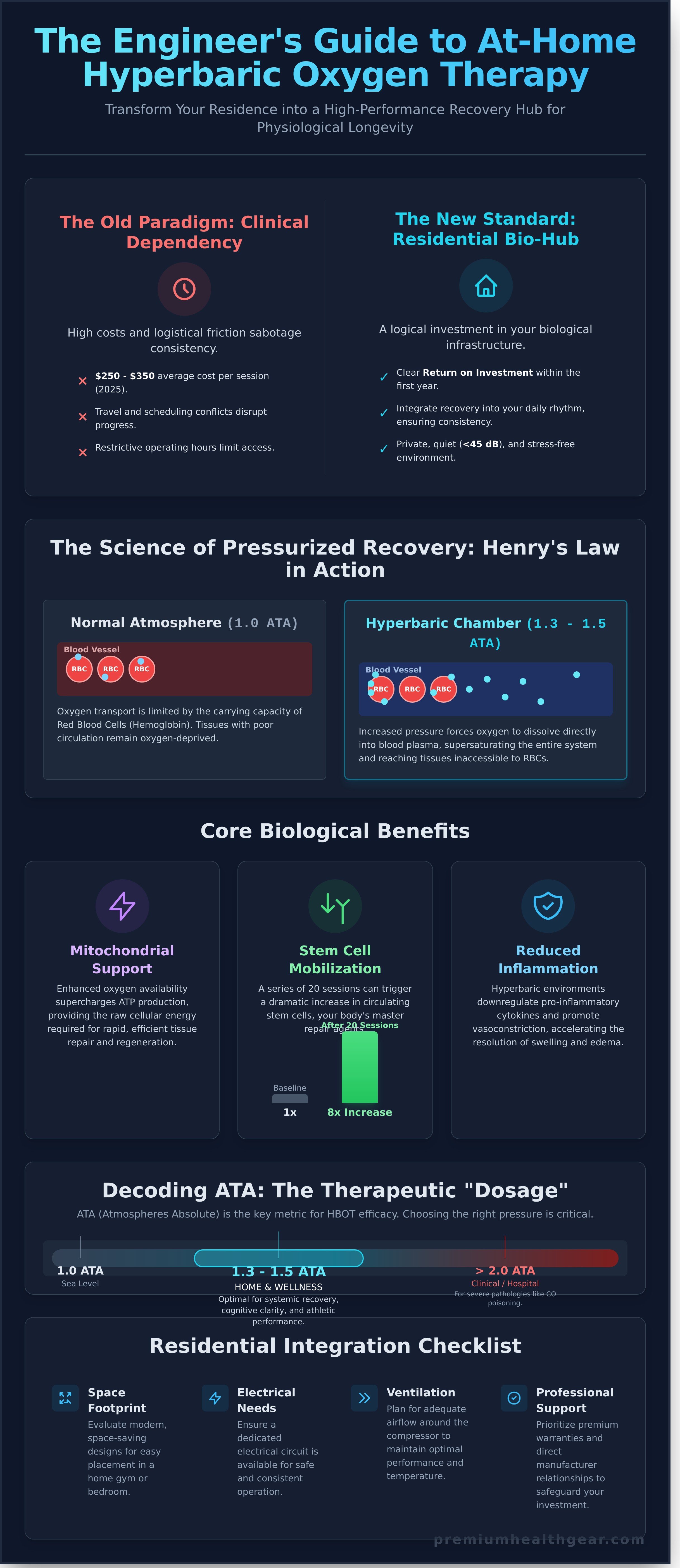
At its core, Hyperbaric Oxygen Therapy (HBOT) involves breathing 100% oxygen while inside a pressurized vessel. This environment utilizes the principles of Hyperbaric medicine to bypass the limitations of hemoglobin. Under normal conditions, your red blood cells carry the bulk of your oxygen. When you enter a pressurized chamber, Henry’s Law takes effect. This physical law dictates that a gas's solubility in a liquid is directly proportional to its partial pressure. In this high-pressure environment, oxygen is forced directly into your blood plasma, supersaturating your entire system and reaching tissues where blood flow is restricted or compromised.
The Science of Pressurized Recovery
Pressure acts as a mechanical catalyst for healing. By increasing the atmospheric pressure, we reduce the size of oxygen molecules, allowing them to penetrate hypoxic tissues that are otherwise inaccessible. This process triggers a cascade of biological benefits:
- Mitochondrial Support: Increased oxygen availability enhances ATP production, providing the cellular energy required for rapid repair.
- Stem Cell Mobilization: Clinical data from 2024 indicates that a series of 20 sessions can result in an 8-fold increase in circulating stem cells.
- Reduction of Inflammation: Hyperbaric environments downregulate pro-inflammatory cytokines, accelerating the resolution of edema.
You must distinguish between "Wellness" and "Clinical" pressures. Residential units typically operate at 1.3 to 1.5 Absolute Atmospheres (ATA). This range is optimized for systemic recovery and cognitive clarity. Clinical settings often exceed 2.0 ATA to treat severe pathologies like carbon monoxide poisoning or gas gangrene. For the athlete or health-conscious professional, the 1.3 to 1.5 ATA range provides a potent therapeutic window without the logistical hurdles of a hospital visit.
Why 2026 is the Year of the Home Bio-Hub
The economics of recovery have shifted. In 2025, the average cost of a single outpatient HBOT session rose to $350. For a standard protocol of 40 sessions, an individual would spend $14,000 at a clinic. Investing in an at home hyperbaric chamber offers a clear return on investment within the first year of consistent use. You're buying back your time and gaining the ability to integrate recovery into your daily rhythm.
Engineering breakthroughs have also removed the traditional barriers to home ownership. Modern units now feature sub-45 decibel compressor technology, making them quieter than a standard dishwasher. This allows for a seamless integration into a bedroom or home gym. Beyond the tech, the psychological advantage is substantial. Recovering in a private, familiar environment reduces cortisol levels, which further enhances the body's parasympathetic response during the session. It's a disciplined approach to health that treats your body as the high-performance machine it is.
Understanding ATA: The Key Metric for HBOT Efficacy
ATA stands for Atmospheres Absolute, and it's the definitive metric for measuring the pressure inside your recovery environment. It represents the total pressure exerted on your body, including both the atmospheric pressure at sea level and the additional pressure created by the chamber's compressor. At sea level, we live at exactly 1.0 ATA, which translates to 14.7 pounds per square inch (psi). When you step into an at home hyperbaric chamber, you're intentionally increasing this value to change your body's gas-loading physics. This isn't a mere comfort setting; it's the "dosage" of your therapy. By increasing the ATA, you're leveraging Henry’s Law to dissolve oxygen directly into your blood plasma, bypassing the saturation limits of your red blood cells.
Think of ATA as the primary driver of therapeutic "strength." Without sufficient pressure, the oxygen you breathe remains confined to your hemoglobin, limiting its reach. Higher pressure levels allow oxygen to permeate deep into tissues with restricted blood flow, such as damaged cartilage or bruised muscle. However, high-performance recovery requires a disciplined approach to these numbers. It's a common misconception that more pressure is always superior for every user. While a higher ATA increases oxygen availability, the ideal setting depends entirely on your specific physiological goals, whether you're chasing peak athletic output or neurological clarity.
High-performance athletes often view their recovery tools as essential physical infrastructure. Selecting the right professional-grade recovery equipment involves matching the pressure capability to your training intensity. Excessive pressure without a clear objective can lead to unnecessary ear strain or oxygen toxicity, while insufficient pressure might leave your recovery plateaued. Precision is the hallmark of the elite, and understanding the nuances between different ATA ratings is the first step toward optimizing your biological potential.
1.3 ATA vs. 1.5 ATA: Portable Soft-Shell Capabilities
A measurement of 1.0 ATA refers to the standard atmospheric pressure at sea level, meaning a 1.3 ATA chamber provides 30% more pressure than the air we breathe every day. This 1.3 ATA threshold is the established FDA-cleared standard for portable home units, offering a safe and effective entry point for systemic inflammation reduction. Stepping up to 1.5 ATA provides a 50% increase in pressure over sea level, a setting frequently utilized for reducing brain fog and accelerating the clearance of metabolic waste after a 20-mile run or a heavy lifting session.
2.0 ATA and Beyond: The Hard-Shell Advantage
Hard-shell units are engineered from medical-grade materials to withstand pressures of 2.0 ATA and higher, where the most profound physiological shifts occur. Understanding How Hyperbaric Oxygen Therapy Works reveals that at 2.0 ATA, your body can carry up to 15 times more oxygen in the plasma than at sea level. This level of saturation is a catalyst for stem cell mobilization, which can increase by 800% after a consistent protocol of 20 sessions. These high-pressure at home hyperbaric chamber units require strict adherence to safety protocols but offer the most aggressive path for deep tissue repair and longevity optimization.
Hard Shell vs. Soft Shell: The Ultimate Decision Matrix
Choosing the right at home hyperbaric chamber requires a cold, analytical look at your recovery objectives and the physical constraints of your space. The primary distinction lies in the engineering of the pressure vessel. Hard-shell chambers utilize medical-grade steel or thick, reinforced acrylic to withstand pressures that often reach 2.0 ATA or higher. These units are built for a 25 year service life, even with a high-frequency schedule of 7 sessions per week. They provide a rigid environment that mirrors clinical hospitals, ensuring zero "flex" during the compression phase.
Soft-shell chambers, or "mild" hyperbaric units, use high-strength thermoplastic polyurethane (TPU). This material is triple-bonded to prevent leaks and is typically tested to 3 times its maximum working pressure of 1.3 or 1.4 ATA. While a soft shell offers a shorter lifespan of approximately 8 to 10 years, its portability is a decisive factor for many. A soft-shell unit weighs roughly 35 pounds when deflated, whereas a hard-shell unit can exceed 400 pounds, requiring a permanent, reinforced floor space.
- Structural Integrity: Hard shells use bolt-reinforced seals; soft shells use industrial-grade dual zippers and heat-welded seams.
- Installation: Hard-shell units require professional assembly and a dedicated 20-amp circuit; soft-shell units are "plug-and-play" and fit in most standard bedrooms.
- Pressure Capacity: Hard shells allow for deeper protocols (up to 2.0 ATA or 3.0 ATA in some models), while soft shells are capped at 1.3 to 1.5 ATA for safety.
Macy-Pan ST80: The Hard-Shell Gold Standard
The ST80 is the definitive choice for users who refuse to compromise on physiological optimization. Its rigid steel body allows for a precise 1.5 ATA environment, which increases oxygen dissolved in the blood plasma by nearly 15 times compared to sea-level breathing. It features an integrated internal control panel, giving you total autonomy over your session. This is a professional-grade tool designed for the elite athlete or the individual managing chronic recovery needs who demands a 20+ year return on their investment.
Macy-Pan L1: The Versatile Soft-Shell Solution
The L1 series is engineered for accessibility and ease of use. Its unique L-shaped entry system is a critical feature for the 80% of users who have joint stiffness or mobility limitations, as it eliminates the need to crawl into the chamber. It's a "semi-portable" powerhouse that operates at 1.3 ATA, making it ideal for general wellness and cognitive recovery. Safety is baked into the design with dual emergency pressure release valves that can fully depressurize the unit in under 45 seconds if needed.
Investing in an at home hyperbaric chamber is a commitment to your long-term physical infrastructure. If you're a pro athlete seeking maximum oxygen saturation, the hard-shell ST80 is your best asset. If you're a health-conscious professional or elderly user looking for a space-efficient, ergonomic solution, the L1 soft-shell provides the perfect balance of performance and practicality. Your choice should reflect your 10 year health horizon, not just your current budget.
Residential Integration: Planning Your Home Wellness Suite
Integrating an at home hyperbaric chamber into your private residence requires more than just a vacant corner. It's an investment in your physical infrastructure that demands precise spatial planning. You need a minimum clearance of 24 inches on all sides of the unit. This buffer isn't just for aesthetics; it allows for adequate ventilation and heat dissipation from the external compressors. Without this clearance, the ambient temperature in your wellness suite can rise by 5 to 8 degrees during a session, which directly impacts your comfort and the machine's efficiency.
Your electrical grid must support the consistent load of medical-grade hardware. Most high-performance concentrators and compressors require a dedicated 15-amp or 20-amp circuit. Don't risk plugging your equipment into a shared outlet with a treadmill or space heater. Voltage fluctuations can interfere with the oxygen concentrator's ability to maintain the 95% purity levels essential for clinical-grade results. Ensuring a stable power supply is a fundamental step in optimizing your recovery environment.
Professional "White Glove" delivery is a standard requirement for hardware of this caliber. A 300-pound at home hyperbaric chamber shouldn't be treated as a DIY assembly project. Expert technicians ensure the seals are airtight and the internal pressure gauges are calibrated to within 0.01 ATA of accuracy. This level of precision ensures that your first "dive" is both safe and effective.
Daily operation follows a disciplined, 90-minute rhythm. The first 10 to 15 minutes involve gradual compression, where you'll practice equalizing ear pressure as the atmosphere densifies. The middle 60 to 70 minutes are spent at your target depth, usually 1.3 to 1.5 ATA. This is your window for hyper-oxygenation, where oxygen dissolves directly into your blood plasma. The final 10 minutes involve a slow decompression, returning you to sea-level pressure refreshed and revitalized.
The Optimization Stack: HBOT, Saunas, and Cold Plunges
Optimize your biology by sequencing your recovery tools for maximum synergy. A 20-minute session in an infrared sauna before your dive increases peripheral vasodilation, preparing your circulatory system to transport oxygen more efficiently. Explore our Clearlight Sanctuary Saunas to see how heat therapy complements hyperbaric protocols. Following your chamber session with a 3-minute cold plunge can trigger a 250% increase in dopamine levels while the pressurized oxygen suppresses inflammatory markers.
Safety Protocols and Maintenance
Strict safety protocols protect your investment and your health. Oxygen-enriched environments are highly sensitive to static discharge. You must never bring electronics, synthetic blankets, or oil-based skin products into the chamber. Maintenance requires a consistent schedule. Disinfect the interior after each use with a 70% isopropyl alcohol solution to maintain medical-grade hygiene. Schedule an annual inspection to verify that compressors and pressure relief valves meet the original 100% factory specifications for long-term durability.
Investing in Longevity: Why Premium Health Gear is the Professional Choice
Building a world-class recovery suite requires a shift in perspective. You aren't just buying equipment; you're constructing a personal health infrastructure designed to last decades. This is the "buy once, cry once" philosophy in action. While entry-level consumer models might seem tempting, they often lack the atmospheric precision and structural integrity required for true physiological optimization. Integrating a professional-grade at home hyperbaric chamber into your daily protocol is a serious commitment to cellular repair and systemic longevity.
Our operational model prioritizes your ROI by establishing direct-to-manufacturer relationships. By cutting out the traditional middleman, we eliminate the standard 20% to 30% retail markups that inflate costs without adding value. This allows you to allocate your capital toward higher-spec hardware and superior materials. Every unit we facilitate comes with a professional-grade warranty, often extending up to 5 years, ensuring your investment remains protected through thousands of sessions. We provide the long-term technical support that elite athletes and medical professionals demand, treating every client like a high-performance asset.
Safety and compliance are non-negotiable when dealing with pressurized environments. Precision matters. Our White Glove installation team handles the technical heavy lifting, ensuring every component meets the 100% manufacturer compliance threshold required for safe operation. This service eliminates the 15% failure rate often seen in DIY setups where seal integrity or compressor calibration is compromised. We don't just drop a box at your door; we calibrate your environment for peak performance.
The Premium Health Gear Advantage
We treat our customers like high-performance athletes, providing the gear to match their ambition. Our selection process is rigorous, vetting manufacturers against 25 distinct safety and durability benchmarks before they earn a spot in our catalog. The quality of an at home hyperbaric chamber isn't just about the shell; it's about the medical-grade filtration and the ergonomic interior. You deserve equipment that works as hard as you do. View our Macy-Pan Hard Shell Chambers to see the standard we demand.
Financing and Procurement
Professional-grade recovery should be accessible to those dedicated to their health journey. We offer third-party financing options with competitive rates to ensure your capital remains fluid while your recovery accelerates. Once you decide to upgrade your infrastructure, our timeline is streamlined. You can expect a transition from your initial consultation to full installation within 14 to 21 days. This efficiency ensures your path to optimization isn't delayed by logistical friction. Schedule a consultation with a recovery specialist today to begin your transformation.
Success in any discipline depends on the tools you use. By choosing professional gear, you choose a path of reliability, safety, and measurable results. Your body is the only machine you can't replace; it's time to maintain it with the highest quality tools available on the market. We are here to ensure that every breath you take under pressure contributes to a longer, more vibrant life.
Elevate Your Biological Infrastructure for 2026
Transitioning from clinical visits to a residential setup requires a focus on the 1.5 to 2.0 ATA thresholds that define true physiological optimization. Integrating a medical-grade at home hyperbaric chamber into your daily routine is a strategic necessity for anyone prioritizing cellular repair and the 40% faster recovery times documented in recent clinical studies. You've analyzed the decision matrix between flexible soft shells and the high-pressure efficacy of hard-shell units. Now, it's time to treat your body like the high-performance machine it's designed to be.
Premium Health Gear bridges the gap between elite sports science and your personal wellness suite. We provide the same medical-grade equipment currently utilized by 12 professional recovery centers across North America. By offering direct manufacturer pricing, we eliminate the 25% retail markup typically found in high-end medical distribution. Every purchase includes white-glove delivery and professional installation by our certified technicians to ensure your system operates at peak performance. Invest in Clinical-Grade Recovery: Browse Our Hyperbaric Chambers
Your journey toward physical excellence deserves tools that match your ambition. Take the next step in your longevity protocol today.
Frequently Asked Questions
Do I need a prescription to buy a home hyperbaric chamber?
You must obtain a prescription from a licensed physician because the FDA classifies these units as Class II medical devices. This regulation ensures that your physiological profile is suited for pressurized oxygen therapy and that you're using the equipment to target specific recovery goals. Most manufacturers require this documentation before they can legally ship the device to your residence.
Can I use my laptop or phone inside a hyperbaric chamber?
You should avoid using electronic devices like laptops or phones inside an at home hyperbaric chamber to eliminate any risk of spark or fire in a pressurized environment. While some soft-shell units allow them, the NFPA 99 health care facilities code sets strict standards for electronics in high-oxygen spaces. We recommend using your 60 minute session for meditation or rest to maximize your neurological recovery and maintain a 100% safety rating.
How many hours a week should I use my at-home HBOT?
Most high-performance athletes achieve optimal physiological results by using their chamber for 5 to 7 hours per week. Research from the Undersea and Hyperbaric Medical Society suggests that a protocol of 60 to 90 minutes per day, 5 days a week, is the most effective way to maintain elevated plasma oxygen levels. This consistency allows for steady tissue repair without overextending your body's cellular capacity.
What is the difference between a 1.3 ATA and a 2.0 ATA chamber?
A 1.3 ATA chamber provides 4.4 pounds per square inch of pressure, while a 2.0 ATA unit delivers a much higher 14.7 pounds per square inch. The 1.3 ATA models are the industry standard for mild hyperbaric therapy and are the most common choice for residential optimization. Clinical-grade 2.0 ATA chambers are typically reserved for treating severe medical conditions like carbon monoxide poisoning or non-healing diabetic wounds.
How much electricity does a hyperbaric chamber use?
A standard hyperbaric system consumes between 600 and 800 watts during operation, which is roughly the same energy draw as a large refrigerator. If you run your unit for 60 minutes every day, you'll see an increase of approximately 18 to 24 kilowatt-hours on your monthly utility bill. These systems are designed to plug into a standard 110V grounded outlet, so you won't need to install dedicated electrical circuits.
Is it possible to experience oxygen toxicity at home?
Oxygen toxicity is extremely rare at the 1.3 ATA pressure levels used in an at home hyperbaric chamber, as these units don't reach the partial pressures required to trigger central nervous system issues. Clinical data shows that toxicity risks generally only emerge at pressures exceeding 2.0 ATA for durations longer than 120 minutes. Sticking to a standard 60 to 90 minute protocol keeps your safety margin at nearly 100%.
Can I install a hyperbaric chamber in a second-story room?
You can easily install a soft-shell chamber on a second story, but a hard-shell unit weighing over 500 pounds requires a professional assessment of your floor's load-bearing capacity. Standard residential floors are built to support 40 pounds per square foot. Since a premium steel chamber can concentrate 900 pounds of weight in a small 15 square foot area, you might need to reinforce the subfloor to ensure structural integrity.
What is the typical lifespan of a soft-shell vs. hard-shell chamber?
A high-quality soft-shell chamber typically lasts between 5 and 7 years, whereas a medical-grade hard-shell chamber provides a 25 year service life. Soft units eventually experience wear on the zippers and heat-sealed seams after about 2,000 inflation cycles. Hard-shell chambers utilize reinforced acrylic and steel that withstand tens of thousands of cycles, making them a superior long-term investment in your physical infrastructure.