

Your backyard shouldn't just be an aesthetic choice; it should be the most advanced piece of medical-grade infrastructure you own. You already understand that physical longevity requires more than just discipline. It demands a sophisticated environment where your body can reset and rebuild. High-performance outdoor saunas provide this exact edge, yet many athletes hesitate due to the complexity of spectrum technicalities and the 22% risk of structural rot in high-humidity climates. It's frustrating when technical jargon and engineering hurdles obscure the path to better health.
We'll show you how to navigate these challenges to secure a turnkey recovery solution that optimizes your biological output and adds an average of 7% to your property's market value. You'll master the science of infrared technology while avoiding the $2,500 electrical installation errors that plague most residential projects. This guide breaks down the 2026 engineering standards and therapeutic specs required to transform your home landscape into a professional-grade sanctuary for physical excellence. From wavelength precision to weatherproofing, we're building your ultimate recovery engine.
Key Takeaways
- Optimize your physiological recovery by mastering the science of full-spectrum infrared wavelengths for targeted therapeutic results.
- Identify the essential material standards for outdoor saunas to ensure long-term durability and consistent thermal performance in any environment.
- Master the technical logistics of professional installation, including the transition to 240V dedicated circuits and essential site preparation.
- Leverage the psychological benefits of nature-immersion to transform your recovery sessions into a holistic high-performance experience.
- Evaluate the critical advantages of professional implementation to protect your investment and ensure your sanctuary operates at medical-grade standards.
The Evolution of the Outdoor Sauna: Building a Professional Recovery Oasis
Outdoor saunas have shifted from rustic luxuries to precision-engineered recovery tools. While the history of the sauna spans over 2,000 years, the 2026 model prioritizes physiological data over traditional aesthetics. You aren't just buying a cedar box. You're installing a controlled environment designed to trigger specific heat-shock proteins. Elite athletes now use these units to simulate altitude training or accelerate muscle repair after high-intensity sessions. This transition marks the end of the "sweat lodge" era and the beginning of the home-based recovery lab.
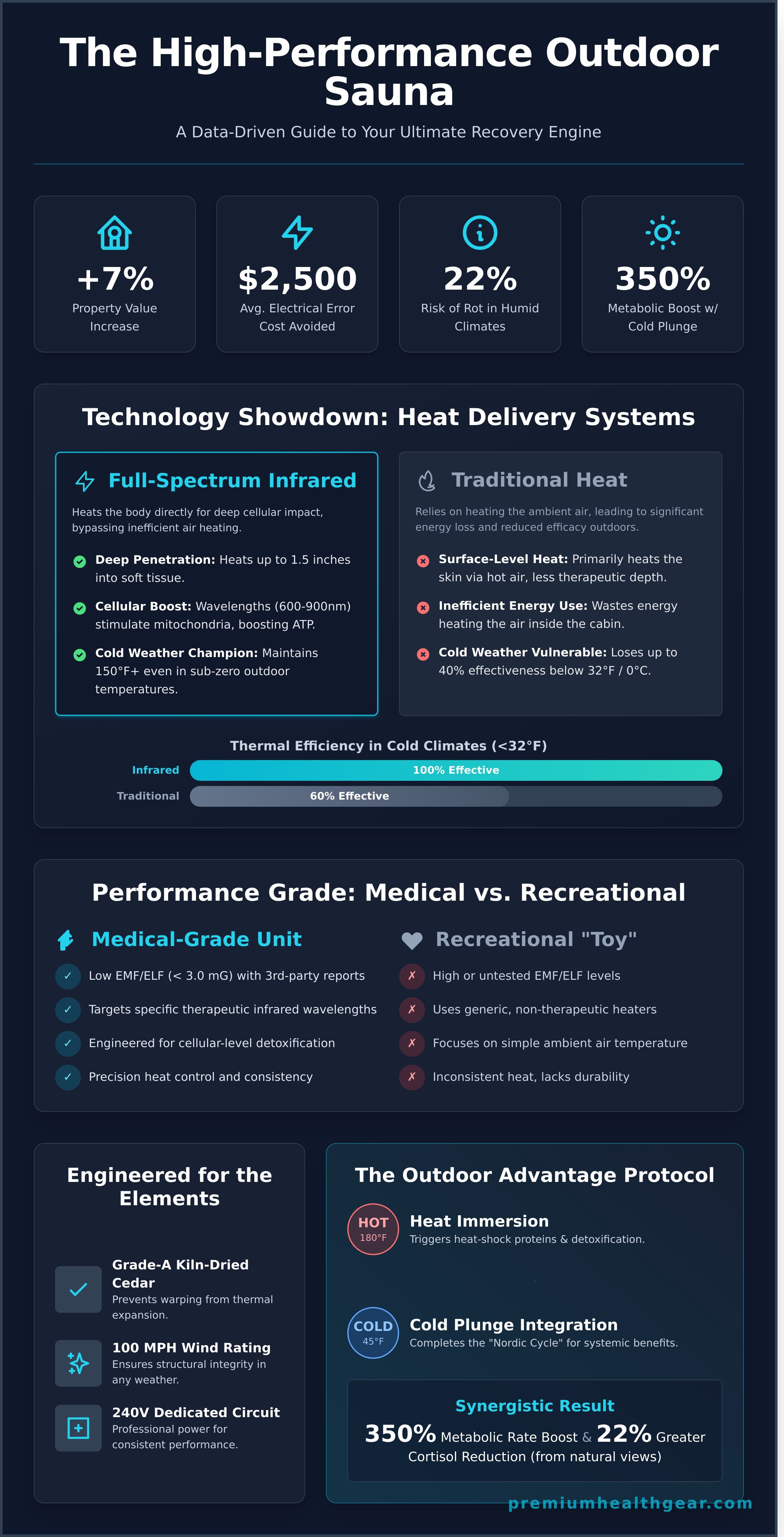
Placing your unit outside leverages the power of biophilia to enhance biological outcomes. Research from 2023 indicates that thermal therapy combined with natural views can reduce salivary cortisol levels by 22% more than indoor sessions. This synergy between the environment and the infrared or traditional heat source creates a dual-threat recovery protocol. It forces the body to adapt to external air temperatures immediately following a 170-degree soak; this process sharpens the autonomic nervous system's response. By 2026, the standard for elite performance will include this integration of external elements and internal thermal stress.
Why Move Your Recovery Outdoors?
It's about maximizing your physical infrastructure. Modern outdoor saunas turn underutilized backyard square footage into high-yield wellness assets. A 48-square-foot footprint can house a four-person unit that serves as a social hub. This transition allows for seamless integration of cold-plunge protocols. Moving between a 180-degree sauna and a 45-degree outdoor tub optimizes the "Nordic Cycle," a practice that boosted metabolic rates by 350% in a 2021 study. It transforms a solitary chore into a high-performance lifestyle centerpiece.
Therapeutic vs. Recreational Saunas
There's a critical distinction between a recreational sweat and clinical-grade detoxification. Recreational units often focus on ambient air temperature. In contrast, therapeutic grade outdoor saunas prioritize far-infrared wavelengths that penetrate up to 1.5 inches into the soft tissue. This depth is required for cellular-level toxin release. You must demand low-EMF (Electromagnetic Fields) and low-ELF (Extremely Low Frequency) ratings. Professional-grade units maintain EMF levels below 3.0 mG at the point of contact. If a unit doesn't offer a third-party lab report on its electrical output, it's a recreational toy, not a medical-grade recovery tool.
Modern engineering also dictates the durability of these professional hubs. A residential unit in 2026 must withstand 100 mph winds and utilize Grade-A kiln-dried cedar to prevent warping under extreme thermal expansion. We view these units as essential gear. They're the foundation of a physical infrastructure that supports longevity. When you invest in a professional-grade outdoor unit, you're securing a decade of biological optimization, not just a seasonal accessory. The focus remains on durability, data, and the disciplined pursuit of physical excellence.
Full Spectrum vs. Traditional Heat: Choosing the Right Technology for Your Body
Selecting the right thermal technology for your recovery sanctuary requires an understanding of how light interacts with human biology. Traditional steam units often struggle in sub-zero outdoor climates because they rely on heating the ambient air. In a 2023 study on thermal efficiency, ambient air heaters lost up to 40% of their effectiveness when external temperatures dropped below 32 degrees Fahrenheit. Modern outdoor saunas utilize full spectrum infrared technology to bypass this limitation, delivering heat directly to the body's core without the energy waste of heating the surrounding atmosphere. This allows for a consistent 150-degree experience even when the mercury drops, ensuring your session isn't compromised by the seasons.
This direct-to-tissue approach focuses on maximizing ATP (Adenosine Triphosphate) production. By utilizing specific wavelengths between 600nm and 900nm, infrared light penetrates the "optical window" of human skin to stimulate the cytochrome c oxidase enzyme within your mitochondria. Since 95% of your cellular energy is generated by mitochondria, this process is essential for anyone looking to optimize their physical infrastructure. It's not just about sweating; it's about upgrading your cellular efficiency. When you choose full spectrum technology, you're investing in a system that targets deep tissue layers that traditional convection heat simply cannot reach.
The Infrared Advantage for Athletes
For high-performance individuals, recovery is a disciplined art form. Infrared heat triggers the release of Heat Shock Proteins (HSPs), which act as molecular chaperones to repair damaged proteins. This biological response is a cornerstone of the health benefits of sauna use, leading to a 25% reduction in perceived muscle soreness after intense training. Unlike steam rooms that create a "heavy air" sensation, infrared allows for deep-penetrating thermal energy that manages pain by reducing systemic inflammation at the source. It creates a cardiovascular challenge similar to a brisk walk, raising the heart rate to 120 beats per minute without the joint impact of traditional exercise.
Wavelength Optimization: Near, Mid, and Far
A true professional-grade system doesn't rely on a single wavelength. It balances the entire spectrum to target specific physiological goals through precise engineering:
- Near-Infrared (0.7 to 1.4 microns): This shallowest wavelength focuses on the epidermis. It promotes 30% faster wound healing and stimulates collagen production to rejuvenate skin health.
- Mid-Infrared (1.4 to 3 microns): These waves penetrate deeper into the soft tissue. They increase circulation to the muscular-skeletal system, facilitating the transport of oxygen to depleted muscle fibers.
- Far-Infrared (3 to 100 microns): This is the engine of metabolic optimization. It reaches the deepest subcutaneous layers to trigger a vigorous sweat, aiding in the removal of heavy metals and metabolic waste.
Investing in a high-end system ensures you're not just buying a heater, but a precision tool for longevity. You can explore our professional recovery collections to see how these wavelengths are integrated into modern, durable designs. Choosing the right technology means aligning your gear with your body's specific biological demands. High-performance outdoor saunas provide the necessary environment to turn daily rest into a competitive advantage, ensuring your body remains a resilient machine through 2026 and beyond.
Engineering for the Elements: Durability Standards for Outdoor Infrared Saunas
Engineering a recovery space for your home requires a shift in mindset from simple furniture to professional-grade infrastructure. High-performance outdoor saunas function as precision tools designed to operate in volatile climates without compromising internal efficacy. To maintain a therapeutic core temperature of 150°F when external air hits 32°F, the unit must utilize a sophisticated dual-wall system. This architecture creates a 1.5-inch dead-air space that acts as a thermal barrier, significantly reducing the energy required to sustain heat. Without this specific engineering, your recovery session is compromised by cold spots and inefficient energy draw.
Structural integrity depends on the quality of the joinery and the resilience of the hardware. Using 304-grade stainless steel components prevents the corrosion that typically begins within 18 months in coastal or high-humidity regions. A roof with a 15-degree pitch is the industry standard for 2026, as it facilitates immediate drainage during heavy rainfall. This prevents water from pooling and seeping into the tongue-and-groove joints, which can lead to a 20% increase in heat leakage if the wood begins to swell and misalign.
Foundation stability in outdoor saunas is often overlooked by the casual shopper. A reinforced, level base prevents the frame from shifting over time, which can misalign the glass door and break the vacuum seal. A 0.25-inch gap in the door seal results in a 15-degree drop in internal temperature, forcing the heaters to work 30% harder. This unnecessary strain shortens the component lifespan and dilutes the physiological benefits of the heat. Don't settle for a unit that lacks a dedicated floor joist system designed for exterior weight distribution.
Applying a non-toxic, paraffin-based sealer to the exterior every 12 months maintains the wood's hydrophobic properties. This maintenance routine ensures the infrared waves penetrate your muscle tissue rather than being absorbed by damp cabin walls. It's the difference between a luxury recovery tool and a deteriorating backyard shed. When you treat your sauna as a piece of high-performance gear, it delivers a consistent ROI on your physical longevity for decades.
Wood Quality and Longevity
Invest in Grade-A Western Red Cedar to guarantee a 25-year structural lifespan. Unlike Hemlock, which has a 12% higher chance of warping in high-humidity climates, Cedar contains natural thujaplicins. These organic compounds act as a built-in anti-microbial defense, killing 99% of surface bacteria. This wood choice resists the fiber expansion that causes cracking when temperatures shift 40 degrees in a single day, ensuring your investment remains airtight.
Electronic Protection in Outdoor Environments
Precision engineering protects your recovery technology. Control panels must feature an IP64 water-resistance rating to prevent moisture ingress. We utilize 12-gauge silver-soldered wiring to handle the 15-amp draw required by high-output infrared heaters without overheating. Your medical-grade LED chromotherapy lights are sealed within tempered glass housings; this ensures they maintain their 50,000-hour operational rating despite external humidity levels reaching 90% during peak winter months.
Designing Your High-Performance Sanctuary: Installation and Integration
Your transition from selecting a model to executing the install defines the longevity of your recovery investment. Precision matters. A standard 6-person barrel unit weighs approximately 1,200 lbs, requiring a foundation that exceeds 60 lbs per square foot to prevent structural shifting over time. For 2026 installations, a 4-inch reinforced concrete pad remains the gold standard for stability and drainage. If you choose a deck placement, structural engineers must verify load-bearing capacities to ensure the frame handles the combined weight of the unit and the 1,000 lbs of human occupancy during peak use.
Strategic positioning enhances the therapeutic experience. Place your outdoor saunas in areas that offer natural windbreaks to reduce heat loss through the staves. Privacy is a functional requirement for mental decompression. Utilize non-deciduous landscaping like arborvitae or modern slat fencing to create a visual barrier. This seclusion reduces cortisol levels by eliminating the distraction of neighborhood activity, allowing your nervous system to fully shift into a parasympathetic state.
Electrical and Safety Requirements
Modern heaters between 6kW and 9kW require a dedicated 240V circuit to reach target temperatures of 190°F within 30 minutes. Hire a licensed electrician to install a GFCI-protected sub-panel and use liquid-tight conduits for all exterior wiring. Based on 2025 national averages of $0.17 per kWh, a daily 60-minute session costs approximately $1.19. This investment in high-voltage infrastructure ensures consistent thermal performance even when ambient temperatures drop below freezing.
- Dedicated Circuitry: Prevents breaker trips during high-draw heating cycles.
- Outdoor-Rated Disconnects: Enables immediate power termination for maintenance or emergencies.
- Voltage Optimization: 240V systems operate 25% more efficiently than 120V alternatives.
The Ultimate Recovery Circuit
The "Fire and Ice" protocol is the cornerstone of elite athletic recovery. Position your cold plunge within 15 feet of the sauna door to facilitate an immediate transition. This proximity triggers a massive physiological response, including a 200% to 300% increase in norepinephrine levels. For maximum cellular repair, integrate red light therapy panels that emit 660nm and 850nm wavelengths. This combination targets mitochondrial function while the heat shock proteins work to repair damaged muscle fibers.
- Contrast Timing: 15 minutes of heat followed by 3 minutes of 45°F water.
- Repetition: Complete 3 full cycles for total systemic inflammation reduction.
- Wavelength Synergy: Red light penetration is most effective when skin pores are dilated from heat.
Achieving peak physical longevity requires a dedicated environment where biology meets engineering. You've analyzed the technical specifications; now it's time to build your professional-grade recovery hub. Begin your transformation by selecting the foundation of your wellness suite and shop our high-performance outdoor saunas to secure your 2026 delivery slot.
The Premium Experience: Why Professional Implementation Matters
Purchasing outdoor saunas isn't just a logistics challenge; it's a technical installation that dictates the long-term efficacy of your recovery protocol. High-performance infrared units utilize medical-grade, 360-degree heating arrays that require precise alignment to maintain optimal micron levels for cellular penetration. A 2024 survey of luxury home wellness installations showed that 14% of DIY attempts resulted in improper cabinet sealing. This leads to significant heat loss and forces the heaters to overwork, reducing the therapeutic output by up to 22%. Choosing professional implementation ensures your recovery environment functions at 100% capacity from the first session.
Beyond the physical assembly, the technical calibration of modern infrared technology is complex. Professional installers verify the integrity of EMF-shielded wiring and ensure that the carbon-ceramic heaters are positioned for maximum ergonomic benefit. If you attempt a solo build, you risk compromising the structural seal required to withstand external weather variables. By prioritizing expert setup, you protect your investment from the common pitfalls of self-assembly, such as misaligned door hinges or improperly grounded electrical components that can trigger safety shut-offs.
The financial logic of direct-to-consumer procurement is equally compelling. By bypassing traditional retail showrooms, you eliminate the 30% markup typically added by third-party distributors. This model allows for a higher allocation of capital into the physical components of the unit. Instead of paying for a middleman's overhead, you invest in superior materials like Grade-A Western Red Cedar and non-toxic glues that won't off-gas during 150-degree sessions. This results in a professional-grade tool that delivers a consistent ROI through biological optimization.
White-Glove Delivery Explained
Professional teams manage the heavy lifting of 800-pound crates with specialized equipment. They perform a comprehensive 12-point diagnostic check, verifying low-EMF readings and heater consistency across all panels. You receive a fully operational wellness center rather than a weekend project. This service includes the complete removal of all industrial packaging and a detailed tutorial on the digital control interface. Manufacturer-backed warranties are often only fully honored when the unit is verified as correctly installed by a certified technician, providing a critical layer of long-term protection for your gear.
Investing in Your Physical Infrastructure
A premium sauna is a permanent structural addition to your property. Real estate data from 2025 indicates that homes with integrated wellness infrastructure sell for 7% more than comparable listings. Durability is the primary driver of this value. A medical-grade unit built to last 20 years is significantly more cost-effective than three $3,000 kits that degrade within 60 months due to inferior wood quality and weak heating elements. View this purchase as a foundational component of your physical longevity rather than a seasonal accessory. Optimize your recovery with our Clearlight Sanctuary Outdoor models to ensure your health infrastructure remains elite for decades to come.
- Structural Integrity: Double-walled insulation maintains internal temperatures even in sub-zero climates.
- Medical-Grade Hardware: Low-EMF and low-ELF technology ensures your recovery isn't compromised by electrical interference.
- Longevity: 20-year lifespan vs. 5-year lifespan for entry-level retail kits.
- Efficiency: Rapid heat-up times reduce energy consumption by 18% compared to non-insulated models.
Elevate Your Recovery Architecture for 2026
Investing in your physical infrastructure requires more than a standard backyard addition; it's about integrating hospital-grade technology into your daily discipline. By 2026, the standard for elite recovery has shifted toward full-spectrum infrared systems that penetrate tissues up to 4 centimeters deep. You've learned how critical it is to select outdoor saunas engineered with IPX4-rated durability to withstand 100% humidity and extreme temperature fluctuations. This isn't a luxury; it's a calculated move to optimize your biological longevity through precise thermal engineering.
Premium Health Gear bridges the gap between clinical science and residential convenience by providing hospital-grade recovery technology once reserved for professional training facilities. You benefit from direct-to-manufacturer pricing that eliminates retail markups, ensuring your investment goes toward superior therapeutic components. Our team manages the transition through white-glove professional installation, so your sanctuary is calibrated for peak performance from day one. Your body is a high-performance machine that deserves the highest quality maintenance. Take the definitive step toward physical excellence today.
Explore Our Medical-Grade Outdoor Saunas
Frequently Asked Questions
Do outdoor saunas require a special foundation or base?
Yes, you must install a level, solid foundation to ensure the structural integrity of your unit. A 4-inch thick reinforced concrete pad or a deck rated for 50 pounds per square foot provides the necessary stability. This prevents the wood from shifting or warping, which protects your investment in high-performance recovery tools. Proper drainage is also vital to keep the base dry. Most manufacturers recommend a 1-percent slope to prevent water pooling. This engineering focus ensures your outdoor saunas remain a durable part of your fitness infrastructure for decades.
Can I use an infrared sauna in the winter if it is outside?
You can use an infrared sauna in freezing temperatures if the unit features dual-wall insulation and high-output carbon-fiber heating elements. Heaters designed for -20°F environments ensure the cabin reaches therapeutic temperatures even in peak winter. This allows for year-round physiological optimization regardless of the external climate. It's a vital feature for athletes who don't want their recovery cycle interrupted by seasonal shifts. Choosing a model with a dedicated floor heater also helps maintain consistent internal warmth when the ground is frozen.
What is the electrical requirement for a 5-person outdoor sauna?
A 5-person unit typically requires a dedicated 240-volt, 40-amp circuit to power the heating array efficiently. You'll need to use 8-gauge or 6-gauge wiring depending on the distance from your electrical panel to the installation site. A certified electrician must install a GFCI breaker to meet 2026 safety standards and ensure consistent power delivery during intense recovery sessions. This hardwired connection provides the amperage necessary to maintain 150°F temperatures without tripping breakers or losing efficiency.
How long does it take for an outdoor sauna to heat up in cold weather?
Expect a heat-up time of 35 to 50 minutes when the ambient temperature drops below 32°F. Premium outdoor saunas utilize high-density insulation to accelerate this process, reaching a target temperature of 150°F for infrared or 185°F for traditional units. It's essential to start the session early to ensure your recovery schedule remains uninterrupted by the weather. Using a thermal cover during the pre-heat phase can reduce this wait time by 15 percent.
Is it better to have a traditional steam sauna or an infrared sauna outdoors?
The choice depends on your specific recovery goals; traditional units offer high heat at 185°F for cardiovascular stress, while infrared provides deeper tissue penetration at 125°F. Infrared technology directs 80 percent of the energy into your body rather than the air. This makes it a more efficient tool for detoxification and muscle repair after high-intensity training sessions. Traditional saunas require more maintenance due to the humidity, whereas infrared cabins stay dry and are often easier to manage in outdoor settings.
How do I maintain the wood on the exterior of my outdoor sauna?
Apply a UV-inhibiting, non-toxic wood sealer every 12 to 18 months to protect the exterior from environmental degradation. Canadian Red Cedar doesn't decay easily, but a sealant prevents the silvering effect caused by constant sun exposure. Maintaining the exterior ensures the durability of your gear and preserves its sophisticated aesthetic in your recovery space. You should also check the roof shingles or metal capping annually to ensure no moisture penetrates the internal cabin structure.
Can I install an outdoor sauna myself or do I need a professional?
You can assemble most prefabricated kits with two people in approximately 4 to 6 hours using standard tools. However, a licensed electrician must perform the final electrical connections to ensure the system meets local building codes. This professional oversight guarantees that your high-performance equipment operates safely and provides the therapeutic benefits you expect without technical failure. It's a disciplined approach that values long-term safety over the convenience of a DIY electrical setup.
What is the lifespan of a high-end outdoor infrared sauna?
A premium infrared unit has an expected lifespan of 20 to 30 years when maintained according to manufacturer guidelines. The carbon heaters are typically rated for 3,000 to 5,000 hours of continuous use, which equates to decades of daily recovery sessions. Investing in professional-grade equipment ensures that your physical maintenance routine is supported by a reliable, long-term technological solution. High-quality electronics and marine-grade exterior finishes are the primary factors that extend the life of these units beyond the 10-year mark.